


Page 70 - Manual_Polaris_RZR_ProXP-20-21
P. 70
GENERAL INFORMATION

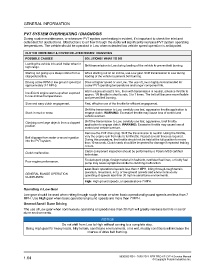
                PVT SYSTEM OVERHEATING / DIAGNOSIS
                During routine maintenance, or whenever PVTsystem overheating is evident, it’s important to check the inlet and
                outlet duct for obstructions. Obstructions to air flow through the ducts will significantly increase PVTsystem operating
                temperatures. The vehicle should be operated in Low when extended low vehicle speed operation is anticipated.

                 CLUTCH DRIVE BELT & COVER RELATED ISSUES: DIAGNOSIS
                 POSSIBLE CAUSES                      SOLUTIONS / WHAT TO DO
                 Loading the vehicle into a tall trailer when in  Shift transmission to Low during loading of the vehicle to prevent belt burning.
                 high range.

                 Starting out going up a steep incline from a  When starting out on an incline, use Low gear. Shift transmission to Low during
                 stopped position.                    loading of the vehicle to prevent belt burning.
                 Driving at low RPM or low ground speed (at  Drive at higher speed or use Low. The use of Low is highly recommended for
                 approximately 3-7 MPH).              cooler PVToperating temperatures and longer component life.

                                                      Warm engine at least 5 min., then with transmission in neutral, advance throttle to
                 Insufficient engine warm-up when exposed  approx. 1/8 throttle in short bursts, 5 to 7 times. The belt will become more flexible
                 to low ambient temperatures.
                                                      and prevent belt burning.
                 Slow and easy clutch engagement.     Fast, effective use of the throttle for efficient engagement.
                                                      Shift the transmission to Low, carefully use fast, aggressive throttle application to
                 Stuck in mud or snow.                engage clutch. WARNING: Excessive throttle may cause loss of control and
                                                      vehicle overturn.
                                                      Shift the transmission to Low, carefully use fast, aggressive, brief throttle
                 Climbing over large objects from a stopped
                 position.                            application to engage clutch. WARNING: Excessive throttle may cause loss of
                                                      control and vehicle overturn.
                                                      Remove the PVT drain plug. Shift the transmission to neutral. Using the throttle,
                                                      vary the engine rpm from idle to full throttle. Repeat several times as required.
                 Belt slippage from water or snow ingestion
                 into the PVTsystem.                  During this procedure, the throttle should not be held at the full position for more
                                                      than 10 seconds. Clutch seals should be inspected for damage if repeated leaking
                                                      occurs.
                                                      Clutch component inspection should be performed by a Polaris MSD certified
                 Clutch malfunction.
                                                      technician.
                                                      Fouled spark plugs, foreign material in fuel tank, restricted fuel lines, or faulty fuel
                 Poor engine performance.
                                                      pump may cause symptoms similar to clutching malfunction.
                                                      Low: Basic operational speeds less than 7 MPH, riding through rough terrain
                                                      (swamps, mountains, ect.), or low ground speeds and when continuously
                 GENERAL RANGE OPERATION              operating at speeds less than 30 mph in sand/dune environments.
                 GUIDELINES:
                                                      High: High ground speeds, or speeds above 7 MPH.
                Operating in Low Gear

                Low gear should be used when riding through rough terrain or when basic operational ground speeds are less than 7
                MPH. Use High gear when basic operational ground speeds are more than 7 MPH.
                General Sand / Dune Driving
                The use of Low gear when continuously operating at speeds less than 30 mph will greatly increase belt life in sand/
                dune environments.
                                                                NOTICE
                                       Do not shift from Low to High without coming to a complete stop.
                 Using High gear for heavy loads, hilly terrain, sand/dune environments, or in wet, muddy conditions will increase the
                                                       chance of drive belt burning.


                1.64                                                       9930583 R01 - 2020-2021 RZR PRO XP / XP 4 Service Manual
                                                                                                © Copyright Polaris Industries Inc.

